Home » CASE STUDIES & ARTICLES » Digital Menu Boards for Restaurants: Benefits and Best Practices
Digital Menu Boards for Restaurants: Benefits and Best Practices
Printed menus age fast. A price changes or a dish runs out, and the menu on the wall is suddenly out of date. Restaurants and takeaway operators are moving to digital menu boards because they solve a problem print can’t, keeping menus current without reprinting anything.
This guide covers what digital menu boards do, and how DMX helps restaurants manage them across one location or many.
What Are Restaurant Digital Menu Boards?
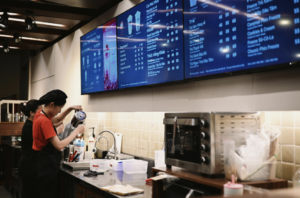
A restaurant digital menu board is a commercial-grade display screen that shows your menu and specials in place of a printed or static board. Content is updated through software, so menu changes can happen in seconds and alleviate the stress and cost of a reprint.
DMX supplies commercial-grade screens for restaurants. The screens are driven by Harmony, DMX’s content management software. On-site installation is handled by local technicians, with 24/7 support available by phone or email.
The Benefits of Digital Menu Boards
Digital menu boards do several useful things at once for a restaurant:
- Real-time updates. Change a price or push a lunchtime promo with a few clicks. No waiting on a printer.
- Lower printing costs. Once installed, you stop paying to reprint menus every time something changes.
- Stronger visuals. High-quality images and video draw the customer’s eye. Pictures of your dishes encourage them to try something new.
- Daypart scheduling. The board can switch menus automatically by time of day, with no staff input needed at changeover.
- Highlight high-margin items. Place your best-selling and highest-margin dishes in the prime spots on the screen and rotate them in featured sections to encourage more sales.
Are Digital Menu Boards a Good Investment?
Restaurant owners often ask if the spend on screens and software pays back. For most operators, the saving on printing covers a meaningful portion of the cost over time. Promoting featured dishes and limited-time offers on the screens also lifts sales, which strengthens the case further.
The size of the return depends on how the boards are used. A board sitting on a static playlist for two years won’t perform like one that’s actively scheduled around peak trading hours and seasonal promotions.
Can You Use a Regular TV as a Digital Menu Board?
A consumer TV will technically display content, but it isn’t built for the job. Home TVs are designed for a few hours of use per day in a controlled environment, with content driven by a remote.
DMX provides commercial-grade screens designed to run continuously in restaurant conditions. Combined with the Harmony media player, content keeps playing even if the internet drops, because published content is downloaded to the player.
A consumer TV plugged into a USB stick has no scheduling, no remote management, no fail-safe playback during internet disruptions, and no support contract. For a restaurant trading every day, those limitations have an impact quickly.
How Much Does a Digital Menu Board Cost?
Pricing varies depending on screen size, number of screens, type of installation, and the scope of content design. A single screen above a counter in a coffee shop is a different conversation to a six-screen layout in a quick-service restaurant with several outlets.
DMX offers digital menu board solutions on a 24-month subscription, which covers the hardware and Harmony content management system. The package is put together based on the brief: what the restaurant wants to achieve and what the space and budget allow.
How Do You Create a Digital Menu?
Creating a digital menu through Harmony is straightforward. There are two routes:
- Use a menu board template. Harmony has a catalogue of menu board templates designed for restaurants. Pick a layout, add your menu items and prices, upload your dish images, and publish.
- Get a fully-branded custom template. The DMX team can build a custom template that matches your restaurant’s look, so the digital menu sits inside your existing visual identity.
Once the menu is built, Harmony’s drag-and-drop interface lets you schedule menu content by location and by time of day. Upload your images and videos, then set the playlist for the screens you’ve chosen.
Design Tips for Restaurant Menu Boards
A few practical pointers for designing menu boards that work hard. Menu engineering research shows that layout and item placement influence what customers order, and the same principles apply to digital boards.
- Keep menu items legible. Customers should read the board comfortably from the back of the queue. Test it before you publish.
- Group items logically. Arrange the menu into clear categories like starters, mains, sides, and drinks, so customers can find what they’re looking for easily.
- Show prices clearly. Pricing transparency builds trust and reduces queue time at the till. The Restaurant Association of South Africa endorses clear menu pricing as part of its industry standards.
- Use video sparingly. Short loops of food being plated or drinks being poured add motion without distracting customers from the menu itself.
- Lead with featured items. A high-margin item or daily special should sit in the top zone of the screen, where you want customers’ eyes to land first.
Managing Menu Boards Across Multiple Locations
Harmony makes it possible to manage menu boards across multiple locations from a single login. You can push a menu update out to every screen at every branch at the same time. If branches need to differ, for example regional pricing or a store-specific promotion, you can run separate menus per location from the same platform.
Brand consistency is held by the central platform. Local managers can be given permissions to edit certain content, while head office retains control of the master menu. For quick service restaurants and franchise operators, that control means a new product launches everywhere in one go and looks the same in every outlet.
Speak to DMX
DMX supplies digital menu boards for restaurants and food service operators across South Africa. This includes commercial-grade screens, the Harmony content management system, professional installation, and ongoing support.
If digital menu boards make sense for your restaurant, the next step is a conversation. Speak to a DMX Customer Experience Consultant to get started.